

 Login
Login



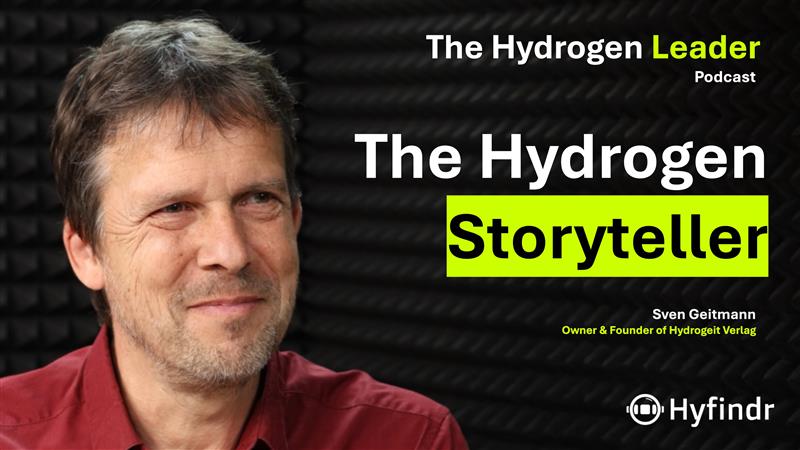
In this episode of The Hydrogen Leader podcast, we sit down with Sven Geitmann, a pioneering figure in German hydrogen journalism and the founder of the highly respected H2-HZWEI. Wasserstoff & Brennstoffzelle magazine. With over two decades dedicated to chronicling the industry’s ups and downs, Geitmann shares his personal journey, his commitment to independent reporting, and his seasoned perspective on the current state of the global hydrogen economy.
The conversation begins with a remarkable backstory: Geitmann and host Dr. Björn Lüssow were childhood classmates, reconnected decades later by their shared passion for hydrogen. Geitmann, a mechanical engineer by education, chose to swap the blueprint for the pen, founding a publishing house and the influential H2-ZWEI magazine. In this discussion, he reflects on his career, offers insights into the market's cyclical nature, and discusses the urgent need for clear governmental commitment to scale the technology.
From Mechanical Engineer to Hydrogen Journalist: The Making of an Independent Voice
Geitmann discusses his pivotal decision to leave a conventional engineering path, choosing instead to write about what others were building. What was the key to his success in establishing the German-language hydrogen magazine, H2-ZWEI, and later, the English H2 International?
The Content Choice: Geitmann recounts his desire to avoid the "gigantism" of building larger machines, opting instead to communicate the technology's promise. He secured the original magazine, H2 Tech, in 2004 for a "really cheap" price from a publishing house that felt they were "much too early" in the market—a testament to his early conviction.
A Global Gap: The launch of H2 International in 2015 was driven by a need to continue the legacy of the former U.S. newsletter, Peter Hoffman’s Hydrogen and Fuel Cell Letter, which had ceased publication. Geitmann felt a responsibility to fill the gap and serve the global English-speaking community.
Maintaining Independence: The Journalist’s Responsibility to Truth
The conversation highlights Geitmann's commitment to independence and quality. How has he maintained a reputation as an objective and reliable source in a field driven by marketing hype?
The Greenwashing Stance: Geitmann shares an anecdote about a prominent instance where he maintained his values. When the world's largest oil company, Saudi Aramco, sought to publish an advertisement, Geitmann decided to run the ad but publish an editorial about greenwashing directly next to it. He then transferred the payment to an association (likely one dedicated to the future of hydrogen), refusing to personally profit from the oil company’s money—a clear dedication to his values.
The Cover Challenge: Geitmann details his criteria for a good cover: it must be vertical, easily legible ("platy" or flat), and have a clear message to spark curiosity. The very first H2-ZWEI cover featured a 1960s hydrogen-powered tractor, illustrating that the technology was "already well known," even if not yet commercialized.
Spotting Trends: The Next Big Stories in Hydrogen
As a "true fish mine on the hunt for the next big story," Geitmann has been an accelerator of new technologies. What were the most impactful stories he discovered and brought to the industry’s attention?
White Hydrogen: His most unique find was hearing a professor in Rio de Janeiro at a World Hydrogen Conference discuss white hydrogen (natural, naturally-occurring hydrogen). This concept—which is now generating significant global excitement and investment—was virtually "unknown" in the European hydrogen world at the time he published the article.
Iron Pellets for Transport: More recently, he highlighted the use of iron pellets (specifically from Ambar Tech) as a potential "world-changing" mechanism for shipping. This method allows hydrogen to be used at the origin and destination, simplifying the long-distance transport challenge.
The Current State: Navigating Hype Cycles and Lows
Having observed the industry since the late 1990s, Geitmann offers a veteran's view on the current market.
The Five-Year Rule: He notes that the industry has been consistently saying, "Hydrogen will come in five years" since 1997. He believes that what many considered a "boom" is now recognized as "another hype," and he forecasts that the "real ramp-up" won't begin until 2030—another five years away.
Pattern Recognition: Geitmann explains that "low" moments, like the current one, often lead to some companies quitting or going bankrupt, but their expertise and assets are absorbed by stronger players. He advises observers not to focus only on "bad news" like a single automaker quitting fuel cell technology (as Stellantis recently did) but on the many companies "still going on" and getting "even stronger."
The Necessity of Political Clarity in Germany
Geitmann stresses that government support has elevated hydrogen to the "top politic" worldwide, with more than 50 countries having a hydrogen roadmap. However, he sees a critical issue in Germany.
A Call for Commitment: He is "still waiting for" a clear and enthusiastic commitment from the German government. He notes that without this political commitment and clear spending signals, companies will continue to "hold their money" and delay final investment decisions.
Clarity Over Uncertainty: Geitmann concludes that while the ultimate question is whether to commit to the energy transition with hydrogen, the most immediate need is clarity—a clear signal that would allow the market to gain certainty and begin the long-awaited ramp-up.
The Next Chapter: Preserving a Legacy
Geitmann reveals that his decision to sell the magazine stemmed from a gradual loss of "curiosity" and the daily "excitement" after decades of reporting.
A Trusted Hand: After a long process, he sold his "baby" to GWV Fachverlage (Genna), a smaller publishing house in Stuttgart, which he views as a very reliable partner. He is "very glad" that H2-ZWEI and H2 International are "in very good hands" with a team that intends to "fulfill what we started."
To hear more from Sven Geitmann on his career, leadership, and the future of independent journalism in the energy sector, listen to the full podcast episode here.
If you found this discussion valuable, don’t forget to subscribe to The Hydrogen Leader podcast. Join Dr. Björn Lüssow for more expert interviews on leadership, innovation, and the future of the hydrogen economy.